A First-Timer's Guide to Brazil — the Practical Stuff, & the Soul of the Place

Updated: Aug 8

This is the guide I wish someone had handed me before I landed: not a listicle of "10 things to pack," but the real shape of the place — what to prepare for, what to let go of, and what nobody tells you until you're already there.
Brazil doesn't reveal itself on a schedule. But you can still show up ready.
General
Location: South America
Capital: Brasília
Population: over 213 million people
Currency: Real (R$) (BRL). 1 R$ = 0.72 AED / 0.17 EUR / 0.20 USD (as of 7th of Aug 2026)
Language: Portuguese
Time Zone: UTC−02:00 to −05:00(BT)
Plugs: Type N
Power: both 127V and 220V
When to Go?

December through March is peak season — hot, festive, and home to Carnival (typically February, sometimes bleeding into early March). It's Brazil at full volume: incredible energy, but also the highest prices and the biggest crowds, and Rio hotel bookings for Carnival fill up close to a year in advance.
If you want the real Brazil without the price tag or the elbow-to-elbow crowds, April–May and September–November are the sweet spot: pleasant temperatures, noticeably fewer tourists, and meaningfully cheaper flights and stays right after Carnival season ends.
June deserves a mention too — it's Festas Juninas season, a massive, joyfully underrated cultural festival period that most first-timers don't even know exists.

Here's the part most guides skip entirely: Brazil is enormous, and "winter" doesn't mean the same thing everywhere. Late May through August is winter season, and depending on where you are, that word actually means something.
Head to Gramado in July and you can genuinely hit temperatures around 7°C — pack like you're going somewhere alpine, not tropical. Porto Alegre is a bit milder during the day, but the second the sun drops, the temperature drops with it, especially if you're staying in a local house or an Airbnb rather than a hotel — bring real warm layers, and a thermos (termo) for something hot is not a joke, it's a survival tool. Santa Catarina stays fairly pleasant temperature-wise, but expect sharp, cold winds that'll cut through anything thin. Once you're at Rio and north, though, you're back in genuinely warm, easy weather — this is the split that catches so many first-timers off guard: they pack for "Brazil" as one climate, and Brazil is actually several.
Money
Brazil runs on Pix — an instant payment system so widely adopted that many locals barely touch cash anymore. For tourists, the practical version of this is simple: your card will work almost everywhere, Uber and 99 (the local ride-hailing app) handle transport without cash, and even small vendors increasingly take digital payment.
One real safety habit worth adopting: only use ATMs inside actual bank branches, not standalone street machines — card skimming at street ATMs is a documented, ongoing issue. And if you do end up using Pix yourself, always enter the payment amount on your own phone — never hand your device to a vendor "to help." That one habit alone prevents the most common Pix-related tourist scam.
For an actual tourist, that's the whole story. For me — someone who'd just moved there and was still in the middle of sorting out residency — it was a little messier. A huge amount of everyday shopping in Brazil happens through small online shops, and most of them only accept Pix. Not cards. Not international cards, certainly. Pix, and only Pix, tied to a Brazilian bank account I didn't have yet. Wondering if it is defferent in 2026 comparing to 2023.
So for months, my system was embarrassingly low-tech: I'd find the thing I needed and send it to Marcus with some version of "I want this" or "we need this." It's a small, slightly humbling detail nobody puts in the "moving to Brazil" guides — that even grocery basics can turn into a two-person operation until your paperwork catches up with your actual life here.
Safety

Brazil currently sits at a Level 2 travel advisory from the U.S. State Department — "exercise increased caution," not "stay away." For the overwhelming majority of tourists, the real risk isn't violent crime; it's preventable, patterned property crime: phone snatching, card-skimming, rigged street taxis, and opportunistic theft in tourist-dense areas like Copacabana and Ipanema.
The habits that actually matter:
Use Uber or 99 instead of flagging a street taxi
Keep your phone in a front pocket, not a back one or an open bag
Never let your card leave your sight during payment
Avoid wandering with visible valuables after dark, especially alone
If you are ever confronted for your phone or wallet — hand it over. It's not a moment to negotiate.
None of this is meant to scare you out of going. It's meant to make you the kind of traveler who doesn't end up as someone else's cautionary story. Find out more here.
The Health Stuff
Brazil does not require a yellow fever vaccine to enter the country, even from at-risk areas. But it's still strongly recommended by Brazilian health authorities, especially if you're heading anywhere near the Amazon — and it needs about 10 days to become effective, so timing matters if you decide to get it.
Beyond that, hepatitis A is commonly recommended for any Brazil trip, since it spreads through food and water. If you're heading into rural or Amazonian areas, ask a travel clinic about additional coverage.
Power & Plugs
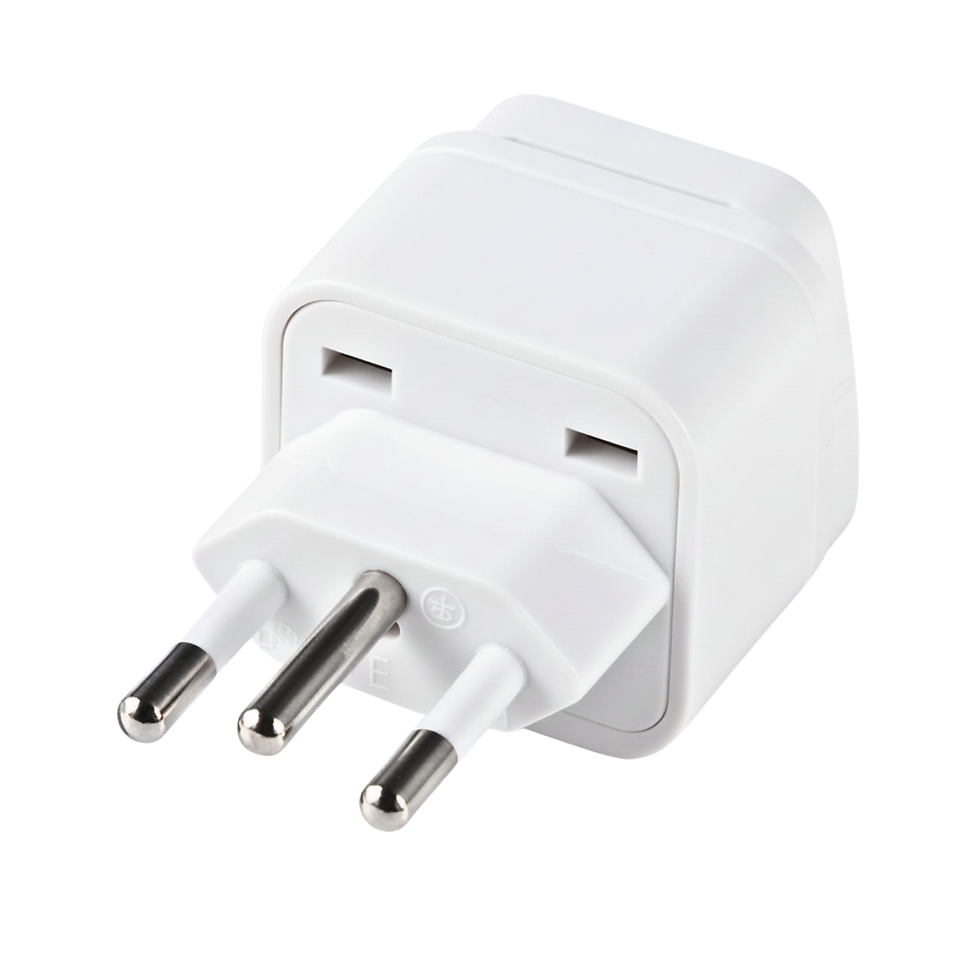
Brazil uses Type N plugs — a rounded three-pin socket that's genuinely uncommon outside Brazil, so don't assume a "universal" adapter from a previous trip will just work; check that it specifically covers Type N or Brazil.
The voltage is where it gets messier: Brazil runs on both 127V and 220V, and which one you get depends entirely on the region — sometimes even the specific building. Rio and São Paulo are commonly 127V; Brasília and much of the Northeast run 220V. Most modern electronics (phone chargers, laptops, camera batteries) are dual-voltage and handle either fine — check the fine print on the charger itself, it'll say something like "INPUT: 100–240V." Anything that heats up — hair straighteners, dryers — is the real risk. Bring a dual-voltage one, or accept you might be air-drying your hair for six months, as I did.
Shopping & Souvenirs
Skip the generic keychains. Brazil's real souvenir game is better than that:

Havaianas — genuinely born in Brazil, absurdly cheap here compared to anywhere else, and they take up zero suitcase space.
A canga — the Brazilian beach sarong/wrap, lightweight, colorful, and actually useful once you're home, not just a shelf object.
Cachaça — the sugarcane spirit behind every caipirinha; buy the aged gold version from a proper shop, not the airport, for something you'll actually enjoy drinking later.
Semi-precious stones and jewelry — Brazil produces a huge share of the world's colored gemstones, especially around Minas Gerais; a small stone piece is a genuinely unique, packable gift.
A football jersey — not just tourist kitsch here; it's a real piece of the culture, and easy to find both official and market versions.
A chimarrão set — if you make it down south (Rio Grande do Sul and the gaúcho region), this is the one to bring home: the hollowed gourd (cuia), the metal straw (bomba), and a bag of yerba mate. It's not just a souvenir, it's an entire daily ritual down there — locals sip it constantly, shared from one cup, passed hand to hand. Even if you never drink mate again, the gourd alone makes a genuinely striking, conversation-starting object back home.
Capim-dourado ("golden grass") jewelry and ornaments — a lesser-known one, handwoven from a native golden grass around Jalapão in the north; delicate, unlike anything you'll find outside Brazil, and directly supports the artisan communities that make it.
Clay figurines from Pernambuco — a folk-art tradition started by the sculptor Mestre Vitalino, now influential enough that the Louvre holds pieces in its permanent collection; a small original is a real piece of Brazilian art history, not a mass-produced trinket.
For where to actually shop rather than just what to buy: Mercado Municipal (Mercadão) in São Paulo is equal parts food market and souvenir hunting ground — go hungry. In Rio, the Sunday fair at Praça General Osório in Ipanema is where you buy directly from the artists making the work, not a middleman. Both beat any airport gift shop by miles.
Tipping
Tipping is loose, not rigid. Around 10% at sit-down restaurants is appreciated, but it's frequently already built into the bill — check before you double-tip out of politeness.
The Part I Actually Can't Explain to You
Here's the honest truth: none of the practical stuff above prepares you for what it actually feels like to be there. Brazil runs on a rhythm that doesn't match a checklist — plans shift, "later" means something looser than you're used to, and somehow it still all works out more often than it should.
I came for one person. I stayed for six months. I left still not fully understanding how the place worked — and missing it anyway, almost immediately.
That's the part you can't research your way into. You just have to go and feel it.


Comments